Shelves filled with field guides and reference books

BUILD YOUR FIELD LIBRARY

The right book depends on what you want to find.

No single mushroom guide does everything well. Start with a strong regional book, then add more specialized references as your interests grow.

AMS RECOMMENDS

Books we would actually hand to someone.

Every book on this page has been recommended by Alabama Mushroom Society leadership.

Broad field guides are useful because they introduce many kinds of fungi. More specialized books usually cover fewer groups in much greater depth.

Most people are better served by several good references than by trying to find one enormous book that answers every question.

AMS does not receive compensation for these recommendations except for sales of the book published by our society.

ALABAMA-FIRST PICKS

Start close to home.

A guide written for the Southeast usually earns more space in an Alabama field bag than a book attempting to cover an entire continent.

Cover of A Field Guide to Mushrooms of the Carolinas
STRONG KEYS

A Field Guide to Mushrooms of the Carolinas

Alan Bessette, Arleen Bessette & Michael Hopping

A useful Southeastern guide with approachable identification keys and good coverage of many fungi also encountered in Alabama.

Find a copy →
Cover of Appalachian Mushrooms
APPALACHIAN REGION

Appalachian Mushrooms

Walter Sturgeon

A strong field reference for Appalachian, Piedmont, mountain, and forest habitats that overlap substantially with northern and eastern Alabama.

Find a copy →
Cover of A Field Guide to the Mushrooms of Georgia
VERY RELEVANT TO ALABAMA

A Field Guide to the Mushrooms of Georgia

Alan Bessette, Arleen Bessette & Michael W. Hopping

Georgia shares much of Alabama's climate, vegetation, and fungal diversity, making this a particularly useful regional reference.

Find a copy →
Cover of Mushrooms of the Gulf Coast States
GULF COAST

Mushrooms of the Gulf Coast States

Regional field guide

Written specifically for Texas, Louisiana, Mississippi, Alabama, and Florida, this fills an important geographic niche—particularly for fungi of southern Alabama and the coastal plain.

Find a copy →
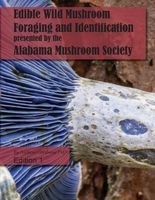
Cover of Edible Wild Mushroom Foraging and Identification

FROM THE ALABAMA MUSHROOM SOCIETY

Edible Wild Mushroom Foraging & Identification

Anthoni Goodman & Alabama Mushroom Society

Learn a manageable group of edible mushrooms well instead of trying to eat everything with a cap.

This guide focuses on readily identifiable edible mushrooms found in Alabama and nearby states, with particular attention to the characters that establish an identification and the look-alikes that need to be ruled out.

The book contains more than 500 photographs across 220 pages and organizes mushrooms by form to make the learning process approachable for newer foragers.

220 pages
500+ photographs
AL + REGION geographic focus
Buy directly from the printer

BIGGER REFERENCES

When a regional field guide isn't enough.

These books cover large portions of North America or unusually broad groups of fungi. They belong on the shelf even when they do not belong in your pocket.

Cover of Mushrooms Demystified
THE CLASSIC

Mushrooms Demystified

David Arora

An enormous identification reference with a depth of practical information that remains difficult to match.

Published taxonomy is now substantially dated in places. Use the identification information, but cross-check current scientific names.

Find a copy →
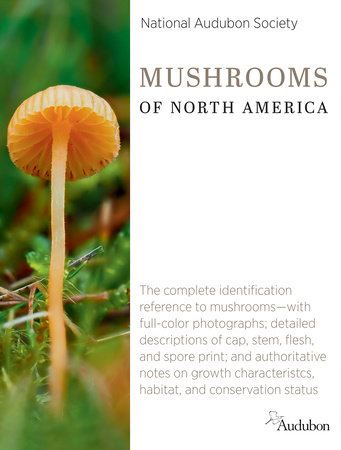
Cover of the updated Audubon mushroom guide
MODERN GENERAL REFERENCE

National Audubon Society Mushrooms of North America

Updated edition

The modern Audubon treatment replaces the old 1981 guide with updated classification and an extensive collection of color photographs.

Find a copy →
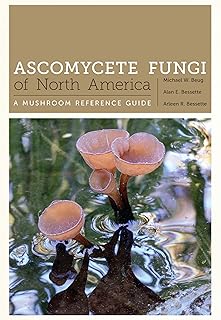
Cover of Ascomycete Fungi of North America
A DIFFERENT HALF OF THE HOBBY

Ascomycete Fungi of North America

Michael Beug, Alan Bessette & Arleen Bessette

A substantial reference for the enormous ascomycete branch of the fungal kingdom—including many cups, morels, clubs and other forms poorly represented in ordinary mushroom guides.

Find a copy →

SPECIAL INTEREST

Eventually, one group gets its hooks into you.

Specialist books become valuable when the few pages devoted to a group in a general field guide stop answering your questions.

Cover of Boletes of Eastern North America
BOLETES

Boletes of Eastern North America

The more geographically focused and newer bolete reference from the Bessettes and William Roody. Particularly useful for our region.

Find a copy →
Cover of North American Boletes
BOLETES

North American Boletes

The older broad North American treatment by Alan Bessette, William Roody and Arleen Bessette. Still a useful companion to newer regional work.

Find a copy →
Cover of Milk Mushrooms of North America
MILKCAPS

Milk Mushrooms of North America

A field guide to Lactarius and allied fungi by Alan Bessette, David Harris and Arleen Bessette, covering more than 150 species.

Find a copy →
Cover of Tricholomas of North America
TRICHOLOMA

Tricholomas of North America

A focused treatment of the large genus Tricholoma, with more than 100 species and extensive color plates.

Find a copy →
Cover of Waxcap Mushrooms of Eastern North America
WAXCAPS

Waxcap Mushrooms of Eastern North America

A dedicated treatment of the colorful members of Hygrophoraceae by Alan Bessette, William Roody, Walter Sturgeon and Arleen Bessette.

Find a copy →
Cover of Amanitas of North America
AMANITA

Amanitas of North America

Britt Bunyard and Jay Justice's dedicated treatment of one of the most conspicuous, ecologically important, and identification-heavy mushroom genera.

Find a copy →
Cover of How to Identify Mushrooms to Genus III
MICROSCOPY

How to Identify Mushrooms to Genus III

David Largent, David Johnson and Roy Watling's reference on microscopic characters, equipment, techniques, and interpretation.

Find a copy →
Cover of Polypores and Similar Fungi of Eastern and Central North America
POLYPORES

Polypores and Similar Fungi of Eastern and Central North America

Alan Bessette, Dianna Smith and Arleen Bessette. A much-needed modern field guide with useful keys, strong color photography, and coverage extending beyond the handful of conspicuous polypores found in general guides.

Find a copy →
Cover of A Mushroom Word Guide
LANGUAGE

A Mushroom Word Guide

Robert Hallock's guide to the etymology, pronunciation, and meanings of more than 1,500 words used in mushroom and fungal identification.

Find a copy →

FORAGING LIBRARY

Identification first. Cooking second.

Foraging books are most useful when they teach why an identification is correct—not merely whether a mushroom has been called edible.

AMS PICK

Edible Wild Mushroom Foraging & Identification

Alabama-focused, photograph-heavy, and deliberately limited to a manageable group of edible species.

Buy from the printer →
BEGINNER

100 Edible Mushrooms

Michael Kuo's approachable guide covers identification difficulty, look-alikes, habitat, and cooking for 100 edible fungi.

Find a copy →

BEFORE YOU BUY ANOTHER GUIDE

What makes a mushroom book useful?

01

Geography

A beautiful guide to western mushrooms can be much less useful in Alabama than a smaller book written for the Southeast.

02

Identification tools

Look for usable keys, comparisons, descriptions of diagnostic characters, and discussion of similar species.

03

Useful photographs

A mushroom guide should show more than attractive cap photographs. Undersides, stems, bases and variation matter.

04

Depth

General guides introduce groups. Specialist books become more valuable once you start trying to separate similar species within those groups.

05

Publication date

Newer books usually reflect more current taxonomy, but an older reference can still contain excellent morphological and ecological information.

06

Your interests

Buy the book that answers questions you are already asking in the field. That is usually the one you will actually use.

NAMES CHANGE

An old book can still be a good book.

Fungal taxonomy changes faster than bookshelves do.

DNA sequencing and taxonomic revision regularly move familiar species into new genera, split one old name into several species, or reveal that North American fungi are not the same organisms as similarly named European species.

That does not make older books useless. Morphology, ecology, field characters, and identification discussions can remain extremely valuable.

Treat the scientific name as something to verify, especially when using older references.

BUILD THE SHELF CHEAPER

Used books are still books.

Many specialist references are expensive or out of print. Before paying collector prices for a new copy, check the used-book market.

BOOKS + MUSHROOMS

Take the guide into the woods.

The best reference becomes much more useful once the terminology on the page is connected to a mushroom in your hand.

Powered by Wild Apricot Membership Software